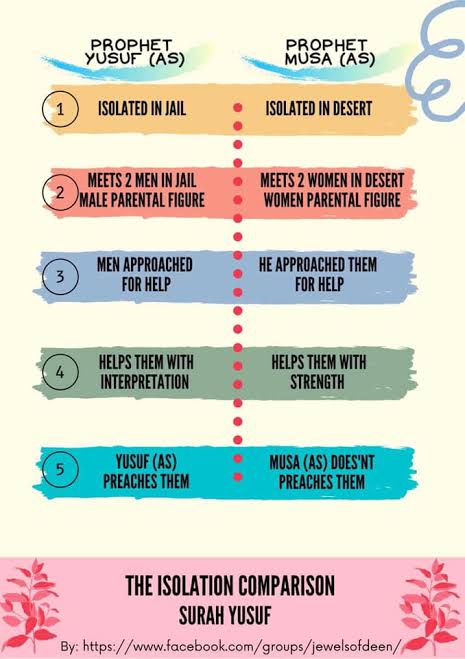
The Miraculous Symmetry between Surah Qasas And Surah Yusuf

Things I have noticed while reflecting on the story of Yusuf (A.S) and the story of Musa (A.S), while comparing Sura Yusuf and Sura Qasas. I thought it beneficial to share.

1. The story of Yusuf makes you wonder why the mom was never mentioned; the story of Musa makes you wonder why the dad was never mentioned

2. Yusuf story begins with the interaction between father and son; Musa story begins with the interaction between mother and son

3. In Yusuf story, his siblings were the reason Yusuf got separated from his family; In Musa story, his sibling was the reason Musa got reunited with his family

4. In Yusuf story, the siblings convinced their dad INTELLECTUALLY to let go of Yusuf; In Musa story, Allah convinced the mom EMOTIONALLY to let go of Musa

5. In Yusuf story, the dad (who IS a prophet) was NEVER told if he will ever reunite with his son; in Musa story, the mom (who is NOT a prophet) was told that she WILL reunite

with her son 6. In Yusuf story, the dad cries tears of sadness; in Musa story, the mom cries tears

of happiness 7. Yusuf got dumped in a standing water (well); Musa got dumped in a flowing water

(River)

8. Yusuf was brought to his new house by a male figure (Egypt’s minister); Musa was brought to his new house by a female figure (Pharaoh’s wife)

9. In Yusuf story, the minister told his wife to either take him as a slave or as an adopted son; In Musa story, pharaoh’s wife told her husband to either take him as a slave or as an adopted son

10. In Yusuf story, I expected the minister’s wife to take Yusuf as a son, because they never had kids, but he was taken as a slave instead; In Musa story, I expected the pharaoh to take Musa as a slave, because he was an Israelite, but he was taken as an adopted son instead

11. Yusuf’s life changed from a life of dignity. to a life of slavery; Musa’s life changed from

a life of slavery to a life of dignity 12. In Sura Yusuf, Allah mentions that he gave Yusuf wisdom and knowledge; in Sura Qasas, Allah mentions that he gave Musa

wisdom and knowledge

13. Yusuf was also given an exceptional trait (Looks): Musa was also given an exceptional trait (Strength)

14. Yusuf got into trouble with the Minister’s wife because of his exceptional trait (looks);

Musa got into trouble with the authority because of his exceptional trait (strength) 15. The crime that was about to happen to Yusuf was private in nature; the crime that happened to Musa was public in nature 16. The crime that was about to happen to Yusuf was the killing of a soul (Zina);

The crime that happened to Musa was the killing of a body (murder) 17. Yusuf sought refuge of Allah before the

crime happened; Musa sought refuge of Allah after the crime happened 18. Yusuf, who was innocent, ended up getting detained by the law; Musa, who was guilty, ended up fleeing the law

19. Yusuf, while in Jail, was approached by 2 men; Musa, while fleeing, approaches 2 women 20. Yusuf’s story continues with only one

man: Musa’s story continues with only one woman 21. In Yusuf’s story, Allah teaches us how

a man and a woman should NOT come

together; In Musa’s story, Allah teaches us how a man and a woman SHOULD come together 22. In Yusuf’s story, an EXPECTED friend

got him out of his trial (Jail) after YEARS: In Musa’s story, an UNEXPECTED friend got him out of his trial (being killed) after DAYS 23. In Yusuf’s story, we learn that his friend came to help him because of a SELFISH reason (he wanted to be acknowledged

by the King for the interpretation of the King’s dream); in Musa’s story, we learn that his friend came to help him because of a

SELFLESS reason (he was afraid that Musa will be killed by the authorities) 24. Yusuf helps out the 2 cell-mates by giving Da’wah to them (The power of words), Musa helps out the 2 women by

feeding their sheep (The power of action) 25. In Yusuf’s story, Yusuf expected a favor from his cell-mate, but it did not come immediately, In Musa’s story, Musa did not

expect a favor from the 2 women, but it came immediately 26. Yusuf returns to the court and faces the King, Musa returns to the court and faces

the King 27. In Yusuf’s story, a confession happens (the women who wronged Yusuf admitted their faults); In Musa’s story, a confession happens (Musa himself admitted his fault)

28. Yusuf gets honored by the King; Musa gets humiliated by the King 29. In Yusuf story, we learn that Yusuf got reunited with his brother (Benjamin); In

Musa story, we learn that Musa got reunited with his brother (Haroon) 30. In Sura Yusuf, Benjamin remained silent; In Sura Qasas, Haroon remained silent

31. In Yusuf story, there was a Sajdah (Yusuf’s family prostrating themselves after being reunited); In Musa’s story, there was a Sajdah (The magicians who lost to Musa) 32. The story of Yusuf answers the question

of how the Israelites came to Egypt: The story of Musa answers the question of how the Israelites left Egypt

SubhanAllah! If this symmetry is not a miracle of the Quran, then I don’t know what is.

How to prevent from Attack of Satan


Steps to Prevent Shaitan


ABDUL SAMAD NIZAMANI
From Quran answer what are steps to prevent attack of shaitan with reference

In the Quran, there are several verses that mention ways to prevent the attack of Shaitan (Satan). Here are some steps mentioned in the Quran:

Seek refuge in Allah: One of the most effective ways to protect oneself from the influence of Shaitan is to seek refuge in Allah. This is mentioned in Surah An-Nahl, verse 98, which says, “So when you recite the Qur’an, [first] seek refuge in Allah from Satan, the expelled [from His mercy].”

Recite Quran: Recitation of the Quran is another powerful tool to ward off the influence of Shaitan. Surah Al-Isra, verse 82, says, “And We have revealed to you, [O Muhammad], the Book in truth, confirming that which preceded it of the Scripture and as a criterion over it. So judge between them by what Allah has revealed and do not follow their inclinations away from what has come to you of the truth. To each of you We prescribed a law and a method. Had Allah willed, He would have made you one nation [united in religion], but [He intended] to test you in what He has given you; so race to [all that is] good. To Allah is your return all together, and He will [then] inform you concerning that over which you used to differ.”

Remember Allah: Remembering Allah through regular remembrance and supplication can help keep Shaitan at bay. Surah Al-A’raf, verse 200, says, “And if an evil suggestion comes to you from Satan, then seek refuge in Allah. Indeed, He is Hearing and Knowing.”

Be mindful of one’s actions and intentions: One should be mindful of their actions and intentions, as Shaitan can take advantage of any weaknesses or negative tendencies. Surah Al-Baqarah, verse 168, says, “O mankind, eat from whatever is on earth [that is] lawful and good and do not follow the footsteps of Satan. Indeed, he is to you a clear enemy.”

Seek forgiveness: Seeking forgiveness from Allah for one’s sins and shortcomings can also help prevent the influence of Shaitan. Surah Al-A’raf, verse 23, says, “They said, ‘Our Lord, we have wronged ourselves, and if You do not forgive us and have mercy upon us, we will surely be among the losers.'”

These are just a few of the steps mentioned in the Quran to prevent the attack of Shaitan. Following these guidelines can help protect oneself from the influence of Shaitan and lead to a more righteous and fulfilling life.

Roadmap to Learn Quranic Arabic with Free resources available


Learn Quranic Arabic.

ABDUL SAMAD NIZAMANI

Roadmap to learn Quran Arabic

Learning Quranic Arabic is an excellent way to deepen your understanding of the Quran and enhance your connection with Allah. Here’s a roadmap that you can follow to learn Quranic Arabic:

  1. Start with the basics: Learn the Arabic alphabet and the sounds of the letters. This will help you read and write Arabic words.
  2. Build your vocabulary: Begin with basic words, phrases, and simple sentences. Focus on words that you encounter frequently in the Quran.
  3. Learn grammar: Arabic grammar is an essential part of Quranic Arabic. You need to understand the rules of grammar to comprehend the meaning of the Quran.
  4. Study Arabic morphology: Understanding Arabic morphology is crucial to understand the meaning of the Quranic words. You will be able to understand the roots of the words and how different forms are derived from the same root.
  5. Read and recite the Quran: Practice reading and reciting the Quran to improve your pronunciation and to develop your understanding of the language. Start with short surahs and gradually move to longer ones.
  6. Take a course or get a tutor: Consider taking an online course or hiring a tutor to guide you through the learning process. A qualified teacher can provide you with personalized attention, feedback, and support.
  7. Immerse yourself in the language: Listen to Arabic audio, watch Arabic videos, and read Arabic texts to immerse yourself in the language. This will help you to learn new words, improve your listening skills, and develop your fluency.

Remember that learning Quranic Arabic requires dedication, patience, and consistency. Don’t rush the process and focus on developing a strong foundation in the language. May Allah guide you on this journey of learning and understanding His message.

ABDUL SAMAD NIZAMANI

Sure, here is a roadmap to learn Quranic Arabic with free resources for each step:

  1. Learn the Arabic alphabet and sounds:
  1. Build your vocabulary:
  1. Learn grammar:
  1. Study Arabic morphology:
  1. Read and recite the Quran:
  1. Take a course or get a tutor:
  1. Immerse yourself in the language:

Remember to practice consistently and take your time with each step. May Allah guide you on your journey to learning Quranic Arabic.

Human needs.

Human Needs: Achieving Them.

ABDUL SAMAD NIZAMANI

Human needs can be broadly categorized into several categories, including physiological, safety, love and belonging, esteem, and self-actualization. Here are some examples of human needs and how they can be achieved:

  1. Physiological needs: These are the most basic needs of human beings, including food, water, shelter, and sleep. To achieve these needs, individuals need to have access to safe and healthy food, clean drinking water, secure housing, and sufficient rest.
  2. Safety needs: These include personal and financial security, health and well-being, and protection from harm. To achieve these needs, individuals may take measures such as investing in personal safety equipment, obtaining health insurance, seeking medical care, or securing their homes.
  3. Love and belonging needs: These needs include the desire for social interaction, meaningful relationships, and a sense of community. To achieve these needs, individuals may participate in social activities, seek out friends and family, or join clubs and organizations.
  4. Esteem needs: Esteem needs include the need for self-respect, recognition from others, and a sense of accomplishment. To achieve these needs, individuals may strive to achieve personal goals, receive praise and recognition for their achievements, or engage in activities that bring them a sense of pride and fulfillment.
  5. Self-actualization needs: Self-actualization needs involve the desire to fulfill one’s potential and achieve personal growth and fulfillment. To achieve these needs, individuals may engage in creative activities, pursue education or professional development, or seek out experiences that challenge them to grow and learn.

In summary, the achievement of human needs depends on a variety of factors, including access to resources, personal choices, and social and cultural norms. By understanding these needs and taking steps to meet them, individuals can live fulfilling, healthy, and meaningful lives.

50 ACTIONALBE INSIGHTS FROM QURAN

The Holy Quran, the central religious text of Islam, offers many actionable insights that can be applied to daily life.

Seek knowledge: The Quran emphasizes the importance of seeking knowledge and understanding the world around us. In many verses, Allah encourages us to think deeply, reflect on the natural world, and ponder the mysteries of the universe.

Practice patience: Patience is a virtue highly regarded in Islam. The Quran teaches us to be patient in all aspects of our lives, from facing adversity to dealing with difficult people. By cultivating patience, we can develop greater inner strength and resilience.

Show compassion and kindness: Compassion and kindness are fundamental values in Islam. The Quran instructs us to be merciful and forgiving to all people, and to show kindness and respect to those in need.

Prioritize prayer: Prayer is a key practice in Islam and an important means of connecting with Allah. The Quran encourages us to pray regularly and seek Allah’s guidance in all aspects of our lives.

Give to those in need: The Quran teaches us to be generous and give to those in need. Zakat, the practice of giving alms to the poor and needy, is one of the Five Pillars of Islam and an important means of purifying our wealth and promoting social justice.

Seek forgiveness: Forgiveness is a central theme in Islam, and the Quran teaches us to seek Allah’s forgiveness and forgive others. By practicing forgiveness, we can cultivate greater inner peace and harmony in our relationships with others.

Act with justice: The Quran emphasizes the importance of justice and fair dealing in all aspects of life. We are called to act with justice and uphold the rights of all people, regardless of their status or background.

Be grateful: Gratitude is a recurring theme in the Quran, and we are encouraged to be grateful to Allah for all the blessings in our lives. By expressing gratitude, we can cultivate a positive outlook and a sense of contentment.

Control our desires: The Quran teaches us to control our desires and avoid indulging in harmful or destructive behaviors. Self-control is an important means of purifying our souls and achieving greater spiritual growth.

Practice moderation: The Quran emphasizes the importance of balance and moderation in all aspects of life. We are encouraged to avoid extremes and pursue a balanced, middle path in our behavior and attitudes.

Stand up for justice: The Quran teaches us to stand up for justice, even in the face of adversity. We are called to speak out against oppression and to promote social justice and equality for all people.

Be humble: Humility is a key virtue in Islam, and the Quran teaches us to be humble and avoid arrogance. By cultivating humility, we can develop greater empathy and compassion for others.

Trust in Allah: The Quran encourages us to place our trust in Allah and have faith in His plans for us. By trusting in Allah, we can develop greater inner peace and resilience in the face of life’s challenges.

Be mindful of our words: The Quran teaches us to be mindful of our words and to speak truthfully and kindly. We are encouraged to avoid gossip, slander, and hurtful speech, and to use our words to build bridges and foster understanding.

Embrace diversity: The Quran celebrates the diversity of human beings and encourages us to embrace and appreciate the differences between us. We are called to reject prejudice and bigotry and to treat all people with dignity and respect.

Serve others: Serving others is a central value in Islam, and the Quran teaches us to be of service to those around us. We are encouraged to give our time and resources to help others, and to work towards the betterment of society as a whole.

Seek knowledge from trustworthy sources: The Quran encourages us to seek knowledge from trustworthy sources and to use our intellects to understand the world around us. We are called to be curious, questioning, and open-minded, and to seek knowledge that will benefit us and those around us.

Be mindful of our actions: The Quran teaches us to be mindful of our actions and to avoid behaviors that are harmful or destructive. We are called to be responsible and accountable for our actions, and to strive towards excellence in all that we do.

Practice self-reflection: The Quran encourages us to reflect on our lives and to assess our behavior and attitudes. We are called to be introspective and to strive towards greater self-awareness and self-improvement.

Foster community: Community is an important value in Islam, and the Quran teaches us to foster relationships with those around us. We are called to build bridges between people of different backgrounds and to work towards creating a more harmonious and just society.

Show compassion: The Quran emphasizes the importance of showing compassion to those around us, particularly to those who are suffering or in need. We are called to be empathetic and to offer our support and care to others.

Be patient: Patience is a recurring theme in the Quran, and we are encouraged to be patient in the face of difficulties and challenges. By cultivating patience, we can develop greater inner strength and resilience.

Forgive others: Forgiveness is a key value in Islam, and the Quran teaches us to forgive others who have wronged us. By letting go of resentment and anger, we can experience greater peace and inner harmony.

Seek guidance from Allah: The Quran encourages us to seek guidance from Allah in all aspects of our lives. By turning to Allah in prayer and supplication, we can find guidance and support in our daily lives.

Seek inner peace: The Quran teaches us to seek inner peace and tranquility, particularly through prayer and meditation. By cultivating inner peace, we can experience greater spiritual growth and fulfillment in our lives.

Strive for excellence: The Quran encourages us to strive for excellence in all aspects of our lives, whether it be in our work, our relationships, or our spiritual growth. By pursuing excellence, we can achieve greater self-actualization and fulfillment.

Be generous: The Quran teaches us to be generous and to give to those in need. By practicing generosity, we can cultivate a sense of abundance and gratitude in our lives, and contribute to the betterment of society as a whole.

Be just and fair: Justice and fairness are central values in Islam, and the Quran emphasizes the importance of treating others justly and fairly. We are called to be impartial and to avoid discrimination or bias in our interactions with others.

Practice humility: Humility is a key virtue in Islam, and the Quran teaches us to be humble in our attitudes and behavior. By practicing humility, we can develop greater empathy and compassion towards others, and avoid arrogance or pride.

Be grateful: The Quran emphasizes the importance of gratitude, and we are called to be grateful for the blessings in our lives. By cultivating a sense of gratitude, we can develop greater contentment and satisfaction in our lives.

Honor our commitments: The Quran teaches us to honor our commitments and to be trustworthy in our dealings with others. We are called to be reliable and dependable, and to fulfill our promises and obligations.

Strive for balance: The Quran encourages us to seek balance and moderation in all aspects of our lives. We are called to avoid extremes and to find a sense of balance in our work, relationships, and spiritual growth.

Be kind to animals: The Quran teaches us to be kind and compassionate towards animals, and to treat them with respect and care. We are called to avoid cruelty and to take responsibility for the welfare of the animals around us.

Be environmentally conscious: The Quran emphasizes the importance of taking care of the environment, and we are called to be responsible stewards of the earth. We are encouraged to avoid waste and pollution, and to work towards a sustainable future.

Seek knowledge: The Quran encourages us to seek knowledge and to engage in lifelong learning. By seeking knowledge, we can develop greater understanding of ourselves, others, and the world around us.

Be proactive: The Quran teaches us to be proactive and to take initiative in our lives. We are called to take responsibility for our actions and to work towards our goals with determination and perseverance.

Seek forgiveness: The Quran emphasizes the importance of seeking forgiveness for our mistakes and shortcomings. We are called to acknowledge our faults and to seek forgiveness from Allah and from those we have wronged.

Be mindful of our words: The Quran teaches us to be mindful of our words and to speak with kindness and compassion. We are called to avoid gossip, slander, and hurtful speech, and to use our words to build up and uplift others.

Embrace diversity: The Quran celebrates the diversity of humanity and teaches us to respect and honor the differences among us. We are called to be inclusive and to seek understanding and connection with those who are different from us.

Practice self-reflection: The Quran encourages us to engage in self-reflection and to examine our thoughts, beliefs, and behavior. By practicing self-reflection, we can develop greater self-awareness and growth in our personal and spiritual lives.

The Holy Quran provides a wealth of actionable insights that can guide us towards a more fulfilling and meaningful life. Among these insights are:

Trust in Allah: We are called to put our trust in Allah and to seek His guidance and support in all aspects of our lives.

Practice compassion: We are called to practice compassion towards ourselves and others, and to show kindness and empathy in our interactions with others.

Foster gratitude: The Quran emphasizes the importance of being grateful for the blessings in our lives, and by doing so, we can cultivate a greater sense of contentment and satisfaction.

Practice humility: Humility is a key virtue in Islam, and the Quran teaches us to be humble in our attitudes and behavior.

Seek balance: The Quran encourages us to seek balance and moderation in all aspects of our lives, avoiding extremes and finding a sense of equilibrium in our work, relationships, and spiritual growth.

Practice forgiveness: The Quran emphasizes the importance of seeking forgiveness for our mistakes and shortcomings, and by doing so, we can cultivate greater humility and empathy.

Practice self-reflection: The Quran encourages us to engage in self-reflection and to examine our thoughts, beliefs, and behavior, thereby developing greater self-awareness and growth in our personal and spiritual lives.

Seek knowledge: We are encouraged to seek knowledge and engage in lifelong learning, thereby developing greater understanding of ourselves, others, and the world around us.

Practice justice and fairness: We are called to be impartial and to avoid discrimination or bias in our interactions with others, thereby fostering greater harmony and understanding.

Honor our commitments: We are called to honor our commitments and to be trustworthy in our dealings with others, thereby fostering greater reliability and dependability.

Be mindful of our words: We are called to be mindful of our words and to speak with kindness and compassion, avoiding gossip, slander, and hurtful speech.

Embrace diversity: The Quran celebrates the diversity of humanity and teaches us to respect and honor the differences among us, thereby fostering greater inclusivity and understanding.

Be proactive: We are called to take responsibility for our actions and to work towards our goals with determination and perseverance, thereby cultivating greater initiative and drive.

By incorporating these insights into our daily lives, we can cultivate greater inner peace, purpose, and fulfillment, while also contributing to a more just, compassionate, and harmonious world.
4 IMPORTANT STORIES IN SURAH KAHF (QURAN)

Lessons learned from Surah Kahf

Surah Kahf is the 18th chapter of the Quran and it contains four stories that offer numerous lessons and insights for Muslims. Here are some of the key lessons that can be learned from Surah Kahf:

  1. The importance of seeking knowledge: The story of Musa (Moses) and Khidr emphasizes the importance of seeking knowledge and the limits of human understanding. It teaches us that even someone as wise as Musa had much to learn and that we should always be open to gaining more knowledge.
  2. The importance of being patient and trusting in Allah’s plan: The story of the Companions of the Cave (Ashab al-Kahf) teaches us about the importance of patience and trusting in Allah’s plan. The young men in the story had to wait for many years before their true faith was recognized and they were saved.
  3. The dangers of arrogance and wealth: The story of the wealthy man and the poor man emphasizes the dangers of arrogance and wealth. It reminds us that no matter how rich or powerful we may become, we are still dependent on Allah for everything.
  4. The importance of relying on Allah for protection: The story of Dhu al-Qarnayn emphasizes the importance of relying on Allah for protection. It teaches us that even the most powerful ruler must rely on Allah’s protection and guidance.
  5. The significance of the Day of Judgment: Surah Kahf also reminds us of the significance of the Day of Judgment and the importance of preparing for it. The story of the people of the town (Ahl al-Qaryah) warns us about the consequences of rejecting the truth and disobeying Allah’s commandments.


Surah Al-Kahf Significance from Hadith

Surah Al-Kahf is one of the most important surahs in the Quran and has been emphasized as such in various hadiths. Here are a few examples:

The Prophet Muhammad (peace be upon him) said: “Whoever recites Surah Al-Kahf on Friday, it will illuminate him with light from one Friday to the next.” (Al-Mustadrak Al-Hakim 2/399)

Abu Sa’eed Al-Khudri reported that the Prophet Muhammad (peace be upon him) said: “Whoever reads Surah Al-Kahf on the day of Jumu’ah (Friday), will have a light that will shine from him from one Friday to the next.” (Al-Bayhaqi)

Ibn ‘Umar reported that the Prophet Muhammad (peace be upon him) said: “Whoever memorizes the first ten verses of Surah Al-Kahf, he will be protected from the Dajjal (Antichrist).” (Muslim)

Abu Darda reported that the Prophet Muhammad (peace be upon him) said: “Whoever memorizes ten verses from the beginning of Surah Al-Kahf, he will be protected from the fitnah (trial or temptation) of the Dajjal.” (Muslim)

Overall, Surah Kahf teaches us about the importance of seeking knowledge, being patient and trusting in Allah’s plan, avoiding arrogance and wealth, relying on Allah for protection, and preparing for the Day of Judgment. These lessons are relevant and valuable for Muslims in all times and places.

20 IMPORTANT Lessons Learned from Surah Baqarah (Quran)

  1. The importance of faith and belief in Allah.
  2. The importance of seeking knowledge and understanding the Quran.
  3. The story of Adam and Iblis teaches us about the consequences of disobedience and the importance of seeking forgiveness.
  4. The story of Prophet Ibrahim teaches us about the importance of sacrifice and devotion to Allah.
  5. The story of Prophet Musa teaches us about the importance of standing up for what is right and the consequences of disobedience.
  6. The importance of establishing prayer and fulfilling our religious obligations.
  7. The importance of giving charity and helping those in need.
  8. The story of Prophet Yusuf teaches us about the importance of patience, perseverance, and trusting in Allah’s plan.
  9. The story of Prophet Dawud teaches us about the importance of justice and using power responsibly.
  10. The importance of avoiding arrogance and seeking forgiveness when we make mistakes.
  11. The importance of unity and avoiding divisions within the community.
  12. The importance of treating others with kindness and compassion, including orphans and the less fortunate.
  13. The story of Prophet Sulaiman teaches us about the importance of using our wealth and resources wisely and for the benefit of others.
  14. The importance of avoiding backbiting and slander, and instead promoting harmony and good relations.
  15. The story of Prophet Zakariya teaches us about the power of prayer and supplication to Allah.
  16. The importance of upholding family ties and treating our relatives with respect and kindness.
  17. The story of Prophet Isa teaches us about the importance of compassion, forgiveness, and mercy towards others.
  18. The importance of standing up against oppression and injustice, even if it goes against our personal interests.
  19. The story of Prophet Muhammad teaches us about the importance of patience and perseverance in the face of adversity and opposition.
  20. The importance of humility and avoiding arrogance, and instead submitting ourselves fully to Allah’s will.

These are just a few of the many lessons that can be learned from Surah Baqarah. It is a rich and complex chapter of the Quran, and there is much wisdom to be gained from studying and reflecting on its verses.

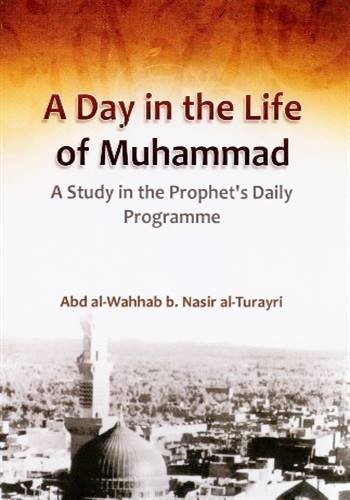
A DAY IN THE LIFE OF MUHAMMAD(صلى الله عليه وآله وسلم)

The book “A Day in the Life of Muhammad(صلى الله عليه وآله وسلم)” by Abd al-Wahhab B. Nasir al-Turayri offers valuable insights into the daily routine of one of history’s most influential figures. By following the example set by Prophet Muhammad (صلى الله عليه وآله وسلم), we can cultivate habits and practices that promote personal growth, kindness, and compassion. This book serves as a reminder that each day presents an opportunity to learn, grow, and serve our communities, and that by incorporating healthy habits and routines into our daily lives, we can achieve our goals and make a positive impact on those around us. Let the example of the Prophet inspire you to live each day to the fullest and strive to become the best version of yourself.

“A Day in the Life of Muhammad” by Abd al-Wahhab B. Nasir al-Turayri is a biographical account of the life of Prophet Muhammad, the founder of Islam. The book is structured as a day-in-the-life narrative, with each chapter covering a different aspect of the Prophet’s daily routine and activities.

The book begins with an introduction to the historical context in which Muhammad (صلى الله عليه وآله وسلم) lived and the social and political conditions of Arabia at the time. It then follows the Prophet through his daily activities, including his morning prayers, interactions with his family and companions, business dealings, and public preaching and teaching.

Throughout the book, the author emphasizes the Prophet’s humility, kindness, and dedication to serving Allah and the community. The narrative also highlights the challenges and opposition that Muhammad (صلى الله عليه وآله وسلم) faced during his lifetime, including persecution and violence from his opponents.

Overall, “A Day in the Life of Muhammad” provides a detailed and accessible introduction to the life and teachings of Prophet Muhammad (صلى الله عليه وآله وسلم), and offers insights into the early history of Islam and the religious and cultural context in which it emerged.

Actionable insights to apply in our life from the book (A DAY IN THE LIFE OF MUHAMMAD)

Based on the book “A Day in the Life of Muhammad” by Abd al-Wahhab B. Nasir al-Turayri, here are some actionable insights that can be incorporated into a daily routine:

  1. Start the day with prayer: Prophet Muhammad (صلى الله عليه وآله وسلم) began his day with prayer and meditation. Starting the day with a moment of reflection or meditation can help set a positive tone for the rest of the day.
  2. Practice kindness and compassion: Throughout his life, Muhammad (صلى الله عليه وآله وسلم) demonstrated kindness and compassion to those around him, regardless of their status or background. Strive to practice kindness and compassion in your daily interactions with others.
  3. Maintain good relationships with family and friends: The book emphasizes the importance of maintaining strong relationships with family and friends. Take time each day to connect with loved ones and cultivate meaningful relationships.
  4. Pursue knowledge: Muhammad (صلى الله عليه وآله وسلم) was a lifelong learner who valued education and knowledge. Make a commitment to learning something new each day, whether it’s through reading, listening to a podcast, or taking a course.
  5. Serve the community: The Prophet was dedicated to serving his community and helping those in need. Find ways to give back to your community, whether it’s through volunteering, donating to charity, or simply offering a helping hand to those in need.
  6. Practice self-discipline: Muhammad (صلى الله عليه وآله وسلم) was known for his self-discipline and commitment to his goals. Set daily goals for yourself and make a concerted effort to achieve them through self-discipline and focus.
  7. End the day with gratitude: At the end of each day, take a moment to reflect on the blessings in your life and express gratitude for them. This practice can help cultivate a sense of gratitude and contentment, even in challenging times.

Atomic Habits (Book Summary)

“Atomic Habits” is a self-help book written by James Clear that explores the idea of developing small, consistent habits to achieve big results in life. The book is divided into four parts, each of which covers different aspects of habit formation.

In Part 1, Clear discusses the concept of “atomic habits,” which are small changes that have a big impact over time. He introduces the idea of the “habit loop,” which consists of a cue, a routine, and a reward. Clear argues that the key to developing good habits is to focus on changing the routine in the habit loop.

In Part 3, Clear discusses how to make habits easy by breaking them down into smaller, manageable steps. He also explores the idea of habit stacking, which involves pairing a new habit with an existing habit to make it easier to remember and follow.

In Part 4, Clear discusses how to make habits rewarding by linking them to a sense of identity or purpose. He explores the idea of identity-based habits, which involve changing your self-image to align with the habits you want to develop.

Overall, “Atomic Habits” provides a comprehensive guide to developing good habits and breaking bad ones. The book is filled with practical advice and real-life examples, making it easy to understand and apply to your own life. Clear’s writing style is engaging and easy to read, and he provides a wealth of information and resources to help readers develop and maintain good habits over time.

Personal Recommendation:

here are some actionable steps

  1. Start with small habits: Break down your goals into small, actionable habits that can be easily accomplished. For example, if your goal is to read more, start by reading just one page a day.
  2. Make habits obvious: Set up your environment in a way that makes it easy to perform your desired habits. For example, if you want to exercise in the morning, lay out your workout clothes the night before.
  3. Use habit stacking: Attach a new habit to an existing habit to make it easier to remember. For example, if you want to start flossing your teeth, do it right after you brush your teetho.
  4. Make habits attractive: Create a reward system for yourself to make your habits more appealing. For example, if you finish a work task, allow yourself to check social media for a few minutes.
  5. Make habits easy: Reduce the friction associated with your habits to make them easier to perform. For example, if you want to start running, invest in a good pair of running shoes.
  6. Use temptation bundling: Pair an enjoyable activity with a habit you want to adopt. For example, only allow yourself to watch your favorite TV show while exercising.
  7. Make habits satisfying: Celebrate your wins, no matter how small, to reinforce the positive feelings associated with your habits. For example, if you complete a workout, take a moment to acknowledge and appreciate the effort you put in.

Remember, habits are the building blocks of our lives. By focusing on creating small, sustainable habits, we can achieve our goals and create the life we desire.

10 Most IMPORTANT PHP Interview Questions

  1. How do you prevent SQL injection attacks when writing MySQL queries in PHP?
  2. Can you explain the difference between mysqli and PDO? When would you use one over the other?
  3. How do you optimize MySQL queries for better performance?
  4. Can you explain the difference between a LEFT JOIN and a INNER JOIN in MySQL?
  5. How do you handle NULL values in MySQL queries?
  6. Can you explain the difference between the mysql and mysqli extensions in PHP?
  7. Can you explain how to use prepared statements in MySQL queries?
  8. How do you handle errors that occur when executing MySQL queries in PHP?
  9. Can you explain how to use indexes in MySQL queries for better performance?
  10. How do you handle concurrency issues when multiple users access the same MySQL database simultaneously?

How do you prevent SQL injection attacks when writing MySQL queries in PHP?

SQL injection attacks are a common security threat in web applications that rely on user input to construct SQL queries. Here are some techniques I would use to prevent SQL injection attacks when writing MySQL queries in PHP:

  1. Prepared Statements: Prepared statements are one of the most effective ways to prevent SQL injection attacks. By using prepared statements, SQL queries and user input are separated, which prevents malicious input from being executed as part of the query.
  2. Input Validation: Input validation is a critical step in preventing SQL injection attacks. By validating user input and ensuring that it meets the expected format and requirements, I can prevent malicious input from being executed.
  3. Sanitization: Sanitizing user input can also help prevent SQL injection attacks. By removing special characters and escape sequences from user input, I can prevent malicious input from being executed as part of the query.
  4. Limiting User Privileges: Limiting the privileges of the MySQL user used by the application can also help prevent SQL injection attacks. By using a user account with limited privileges, I can prevent attackers from executing dangerous queries.

Overall, by using these techniques and following best practices, I can effectively prevent SQL injection attacks when writing MySQL queries in PHP.

Design a site like this with WordPress.com
Get started